
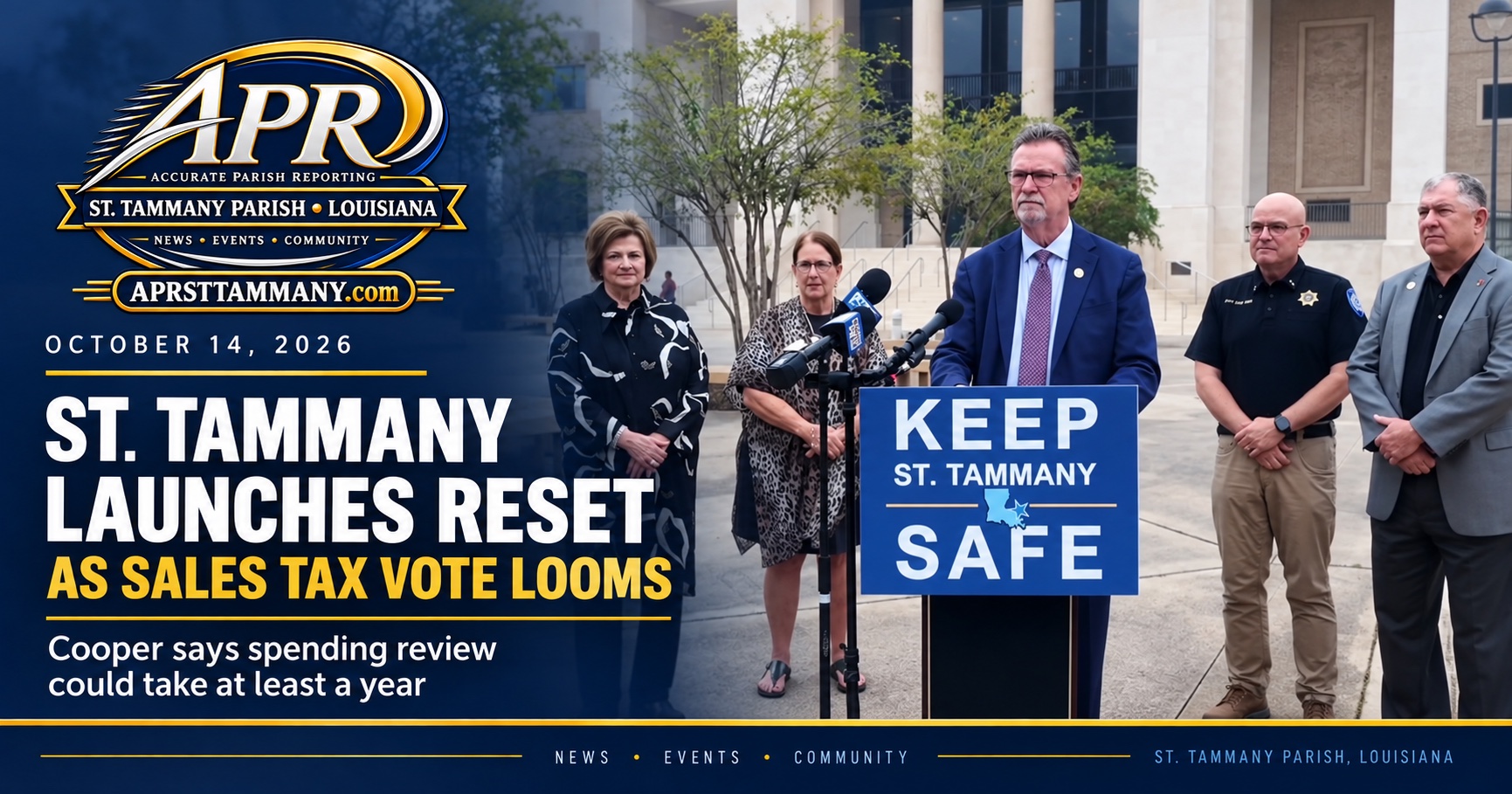
St Tammany Parish President Mike Cooper announced a review of government spending and the parish’s tax structure Wednesday but said recommendations could take at least a year, placing them well beyond a December vote on a proposed public safety sales tax.
The proposed 0.25 percent sales tax, promoted through the parish’s Keep St. Tammany Safe initiative, would last five years. Voters are scheduled to consider the measure December 12.
During the press conference, Cooper acknowledged that the funding problem dates to 2018.
“It’s not a surprise that we do not have sustainable funding to support these agencies,” Cooper said.
Parish records show that two sales taxes supporting jail and Justice Center expenses expired March 31, 2018, after unsuccessful attempts to obtain voter approval for continued funding. More than eight and a half years have passed since their expiration.
Tax vote comes before reform recommendations
The new task force, called RESET, stands for Revenue, Efficiency, Spending, Education and Transparency. Cooper said it would examine spending, shared services, consolidation, the tax structure and possible legislative changes.
Asked whether that work should have occurred before residents were asked to approve another sales tax, Cooper said the efforts were proceeding together. He described the tax proposal as addressing immediate public safety needs while RESET examines broader changes.
Cooper said the task force could hold two organizational meetings before the end of the year, followed by regular meetings next year. Developing recommendations for the Parish Council or state lawmakers would take at least a year, he said.
“We didn’t get this way overnight, and it’s not going to be overnight before we settle it,” Cooper said.
He also said approval of the tax would give the parish up to five years before returning to voters for a renewal or another funding alternative.
Under that timetable, residents would decide whether to approve the additional tax before receiving the task force’s recommendations on spending reductions, consolidation or changes to how government is funded.
Officials warn of cuts to criminal justice funding
Cooper identified the Sheriff’s Office, courts and district attorney’s office as among the agencies most affected by the parish’s financial constraints.
The administration’s written summary of its proposed 2027 budget describes reductions of up to 60 percent in available parish funding for the district attorney’s office, district courts and correctional facility. That figure concerns funding available through parish government, rather than a uniform reduction in every agency’s total operating budget.
Officials warned Wednesday that reduced funding could affect prosecutions, court operations and jail services.
Cooper distinguished those financial pressures from infrastructure funding. The parish says revenue dedicated to infrastructure is legally restricted and cannot simply be redirected to cover other obligations.
Previous spending reviews and reductions
Officials defended earlier efficiency efforts, citing reductions in mosquito control, library and drainage property tax rates. They also described the proposed public safety funding arrangement as allowing participating agencies to share dedicated revenue according to their needs.
RESET is not the parish’s first review of spending following the loss of the 2018 taxes. A June 2018 Streamlining Budget Workgroup report documented roughly $10 million in budget reductions, a hiring freeze and a workforce reduction of approximately 100 positions. That report also recommended restructuring operations and identifying sustainable funding for jail and Justice Center expenses.
Cooper said RESET would bring together elected officials, representatives of taxing districts, business and professional leaders, and residents. Its membership had not been finalized at the time of Wednesday’s announcement.
He said meetings would be streamed live and recorded, with agendas, minutes and other information available online. The task force would select its own chair and establish its priorities.
“We’re not telling this task force what conclusions to reach,” Cooper said.